


HOME | home
Iron on the Hearth | Iron, Cast and Forged | Cast Iron Cooking 4 | Copperware | Copper and Brassware 2 | Brass Alcohol Stove | Pipe Smoking | Tobacco the Indian Weed | Women's Pipes | Clay Pipe Collection | Pipes2 | pipes3 | Pipes4 | Pipe Tampers | Early Lighting 1 | Early Lighting 2 | Early Lighting 3 | Early Lighting 4 | Early Lighting 5 | Early Lighting 6 | My Lamps | Center Draft Lamps | Center Draft Lamps II | Center Drafts III | Miners lamps | Matches and Match Safes
Clay Pipe Collection
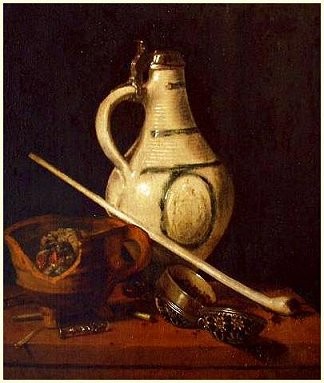 Clay Pipes
In the 17th and 18th Centuries thousands of clay pipes came to the New World and many fragments are still being found in the soil of the earliest settlements. Pipe shards and some intact clays have been excavated on Civil War battlefields and in encampments in great numbers showing the strong presence of clay pipes in the 1860s among the soldiers who fought on both sides. "The Clay" remained king at least among men until the later part of the 19th Century.
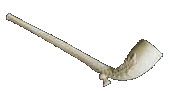
   Clay Pipes, 19th Century or new from old Molds
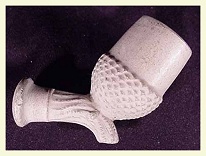
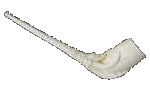 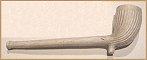  Original 19th Century Ribbed Pipe
 English 18th Century Style,Tavern Clay Pipe
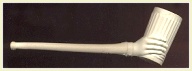 19th C. Gouda Clay
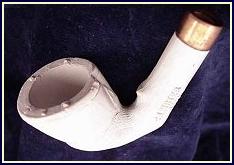 Nice Clay, Shod, Horse Foot, Pipe Bowl made by Gambier in Paris.
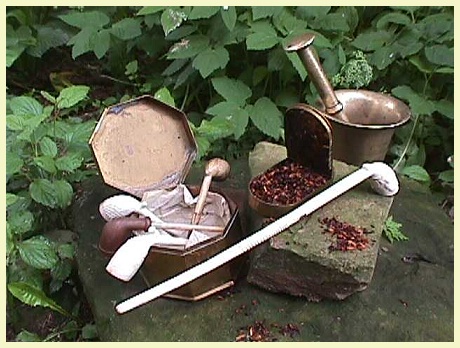 The long pipe has a nice angeled bowl with coat of arms. Pipes like this are often called Church warden pipes or Tavern Pipes. Many clay pipes were allso made in Holland at this time. Thousands were made in Gouda where fine pottery is still made today, a tradition that started in 1630 with the production of clay pipes! The hand extended with a glass is made in Holland. Perfect wouldn't you say, to have a drink of tobacco?
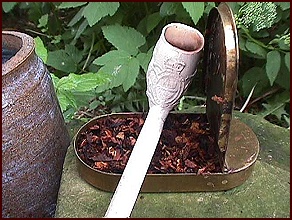 18th Century Style with coat of arms
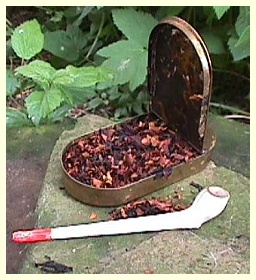 This is a reproduction of a 17th Century Style with tiny bowl often refired
to by folks of the period as the little ladle.
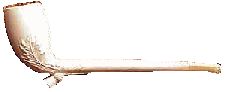 My Thistle Pollock is my favorite 19th Century style Pipe!
I love the Scottish Thistle on the bowl and heal of this nice clay.
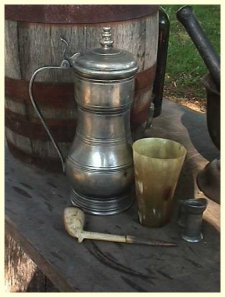 Clay pipes can be repaired with the quill of a turkey or goose as a stem! I have geese here on my homestead but wild turkey works very nice too. Give new life to a broken clay! It may well be the first "plastic" known to man along with cow horn! It's great on the teeth and you can replace them when they get too dirty! I learned this from a book which had a handsome 18th Century pipe with a goosequill for a mouth piece. I first read about quills being used as mouth pieces for clay pipes in a book called Domestic Utensils in Wood by Owen Evans-Thomas . Pipes are in the book because of the wooden pipe cases, tobacco rasps and snuff boxes that are treenware (woodenware). There is an 18th Century pipe pictured that is clay with sterling fittings and a goose quill mouth piece. This pipe is Dutch and it can be found on pages 108 and 109.
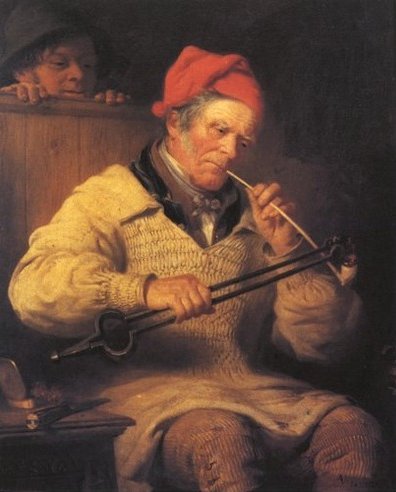  "When temperately used, there is not in all the world a medicine comparable totobacco. All of tobacco is wholesome."
William Barclay: Nepenthes; or, The Virtues of Tobacco, 1614
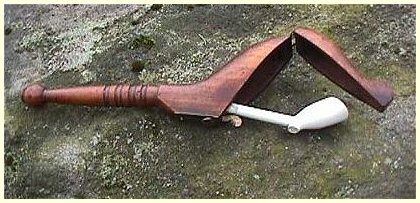 18th Century wooden Pipecase from The Netherlands
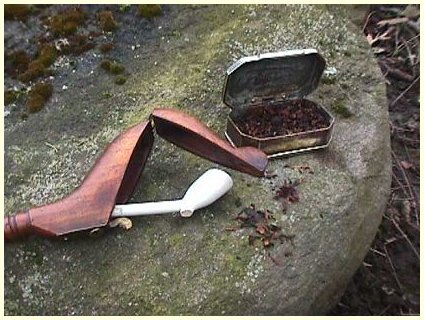 To keep those fragile clays from harm.
 The first clay pipes were introduced to Europeans along with tobacco smoking by the Native Americans of South and North America. It was not long before clay pipemaking became an established trade. Follow the links to learn more history of the Clay in the New World. Later mass produced European and American clay pipes became a trade item and were bartered back to Native American tribes!
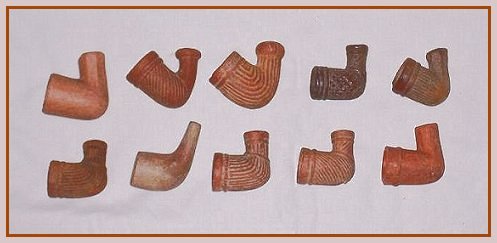 In Virginia the Pamplin Pipe Factory - Located in Pamplin City, Appomattox County, VA is listed on the National Register of Historic Places. Its history dates back to the Appomatucks Indians and their cottage industry of clay pipes. The first major industry in Appomattox was the Pamplin Smoking Pipe Manufacturing Company. Established in 1878, this factory manufactured clay pipes for over 70 years before closing in 1951. The existing Pamplin Pipe Factory was built in 1880. It houses the original clay kiln which once produced one million clay pipes per month. The site now includes a museum.
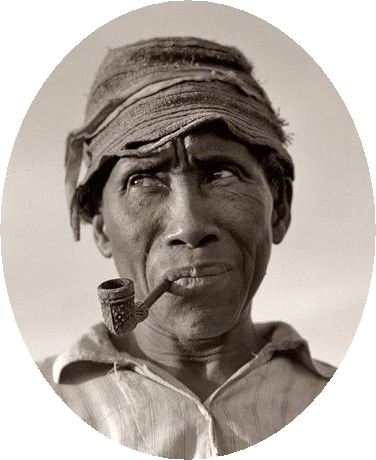 Ohio with its rich clay deposits also had a number of kilns producing this type of pipe. The most famous being the Merrill Pottery of Akron, Ohio. Merrill Pottery occupied the site of the M. O’Neil Department Store building prior to 1927. Merrill also produced ceramic beer bottles.
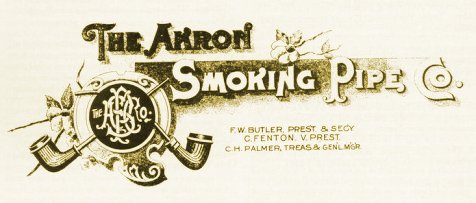 Many Clay pipes can still be collected or dug that were made by the Merrill Pottery better known under its latter name as the Akron Smoking Pipe Co. The Akron Smoking Pipe Co. (1890-1919) was located at 3775 Mogadore Road in Mogadore, OH. It started out as the E. H. Merrill Co., which produced Ohio stoneware and clay specialties. On September 3, 1890, the company was incorporated as The Akron Smoking Pipe Co. (ASPCo) with offices on Falor Street in Akron, OH just west of Main Street in the same building as the Diamond Match Co. It controlled the clay smoking pipe business of five other companies with directors who owned the other companies. One of those Companies was the Pamplin Co. The Pamplin Plant was located in Pamplin City, Virginia, near rich sources of a type of clay found only in Powhattan and Appomattox Counties. The company's mainstay products, Powhattan clay and "stone" smoking pipes were not only included with box matches, but were also packaged for retail sales.
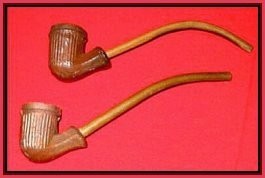 Note the reed stems
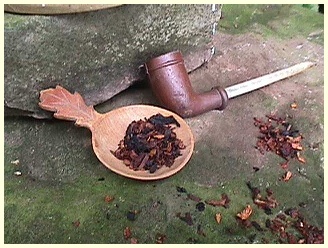 This is a antique trade pipe of brown glazed clay with a quill stem. 19th Century
The Shakers in New York also made Clay pipes with reed stems and ended their manufacture just about the time manufacture began in Akron, Ohio. They were made between 1809 and 1853.
More on Pamplin and Akron Pipes
The Winter 2009/2010 issue of American Archaeology 13(4):36-37, had a short blurb on the acquisition of the Pamplin Pipe factroy by the Archaeological Conservancy (publishers of the magazine). It had a photo of Andy Stout with Raymond and nancy Dickerson in front of the factory. I thought I wwould send around some appropriate urls.
University of Missouri
National Register Nomination Photo #1
Another Pamplin Pipe Variety, Murphy
MOLD MARKS ON MOGADORE, OHIO, REED STEM TOBACCO PIPES James L. Murphy and Kurt Reich, 1973
Pamplin Pipe Factory National Register of Historic Places
Grant announcement by the Governor of Virginia
Pamplin Pipe Factory (The Archaeological Conservancy)Purchase of the 2.96 acre Pamplin Pipe Factory property in Appomattox County. The factory is listed in the Virginia Landmarks Register and National Register of Historic Places for the archaeological remains of two centuries of clay pipe manufacturing. The property will be placed under a historic preservation easement with the Department of Historic Resources. Ownership would be transfered to the Appomattox Historical Society and opened as a museum. Grant Amount $61,000.
The 1972 article in the Missouri Archaeologist is downloadable but you have to subscribe to this service.
Pamplin Pipe Factory (Virginia) (2008 Annual Report of the Archaeological Conservancy page 6)
Just 10 miles east of Appomattox, where the Civil War ended, is the small, remote town of Pamplin, Virginia. It’s thought that pipe making was underway in Pamplin by the 1740s, shortly after the first settlers arrived, and it developed into a cottage industry. The pipes, made from the nearby deposits of red clay, were primarily created by local women. They were fired in backyard, wood-burning ovens and were then packed in barrels and crates lined with pine needles or sawdust by local storeowners. Pamplin pipes were shipped all over the United States. Pamplin’s cottage industry paved the way for the establishment of a factory sometime before 1880 by E. H. Merrill, an Akron, Ohio company that was the leading producer of tobacco pipes in America in the 1850s. The Merrills invented a pipe-making machine, and it’s believed that eight to 10 of these machines were utilized at the Pamplin factory.
National Register of Historic Places final nomination form
http://www.dhr.virginia.gov/registers/Counties/Appomattox/277-0002_Pamplin_Pipe_Factory_1980_Final_Nomination.pdf
'
Special thanks to Michael Pfeiffer for the links.
Murphy, James L.
1967 Reed Stem Tobacco Pipes from Point Pleasant, Clermont County, Ohio.
Northeast Historical Archaeology 5(1-2):12-27.
1974 Nineteenth Century Reed-stem Tobacco Pipes from the Mogadore, Ohio, Dump.
Pennsylvania Archaeologist. 44(4): 52-60.
1974 Provenience of Seven Reed Stem Pipes From Fort Union, New Mexico.
The Kiva 39(3-4):247-251.
1975 Another Pamplin Pipe Variety. Quarterly Bulletin of the Archeological Society
of Virginia 30(1):26-29. (September)
1976a Reed Stem Tobacco Pipes from Point Pleasant, Clermont County, Ohio.
Northeast Historical Archaeology 5(1-2):12-27.
1976b "Cresthull" Reed Stem Tobacco Pipes. The Chesopiean 14(1-2):11-16.
1978 Shaker Reed Stem Tobacco Pipes. Pennsylvania Archaeologist 48(1-2)48-52.
1980 Additional Reed Stem Smoking Pipes from Summit County, Ohio.
The Chesopiean 18(1-2)16-31.
1985 Clay Tobacco Pipes from the Tom Peterson Site (33CT390), Clermont County,
Ohio. Proceedings of the Symposium on Ohio Valley Urban and Historic
Archaeology. 3: 61-71.
1986a Two Tobacco Pipe Molds From the Collection of the Ohio Historical Society.
Historic Clay Tobacco Pipe Studies 3:53-56.
1986b Tobacco Pipe Fragments from Schoenbrunn, Tuscarawas County, Ohio.
Historic Clay Tobacco Pipe Studies 3:65-68.
Murphy, James L., and Kurt Reich
1973 Mold Marks on Mogadore, Ohio, Reed Stem Tobacco Pipes.
Quarterly Bulletin of the Archeological Society of Virginia 28(2):94-96.
1974 Nineteenth Century Reed-Stem Tobacco Pipes From the Mogadore, Ohio, Dump.
Pennsylvania Archaeologist 44(4):52-60.
LINKS
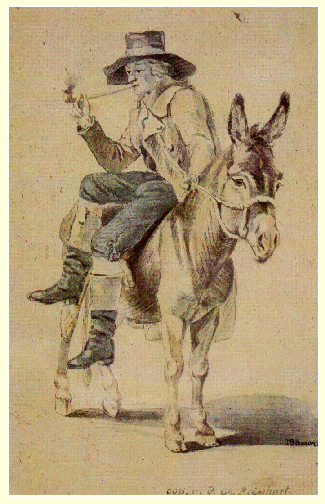
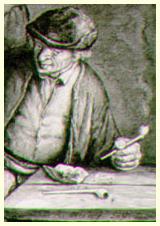   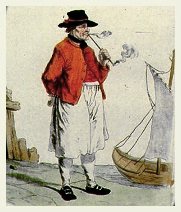 "A Dutchman without a pipe is a national impossibility. If a Dutchman were deprived of his pipe and tobacco, he would not even enter Paradise with a glad heart."
-Schotel
Pipes Pictured from the collection of Beth Maxwell Boyle
 This page is dedicated to my friend Tom who holds both lady smokers and pipe smoking in highest regard.
E-Mail the Webmaster
 I first read about quills being used as mouth pieces for clay pipes in a book called Domestic Utensils in Wood. by Owen Evans-Thomas . Pipes are in the book because of the wooden pipe cases, tobacco rasps and snuff boxes that were all treenware (woodenware). There is an 18th Century pipe pictured that is clay with sterling fittings and a goose quill mouth piece. This pipe is Dutch and it can be found on pages 108 and 109.
  copyright 2002 , Jim & Beth Boyle, All Rights Reserved copyright 2002 , Jim & Beth Boyle, All Rights ReservedNo part of this website may be used for any purpose ( including using images )
without written consent from The Rams Horn
 "There can be no doubt that smoking nowadays is largely a miserable automatic business. People use tobacco without ever taking an intelligent interest in it. They do not experiment, compare, fit the tobacco to the occasion. A man should always be pleasantly conscious of the fact that he is smoking."
-John Boynton Priestley
|